Showing posts with label permittivity. Show all posts

Wednesday, December 17, 2014

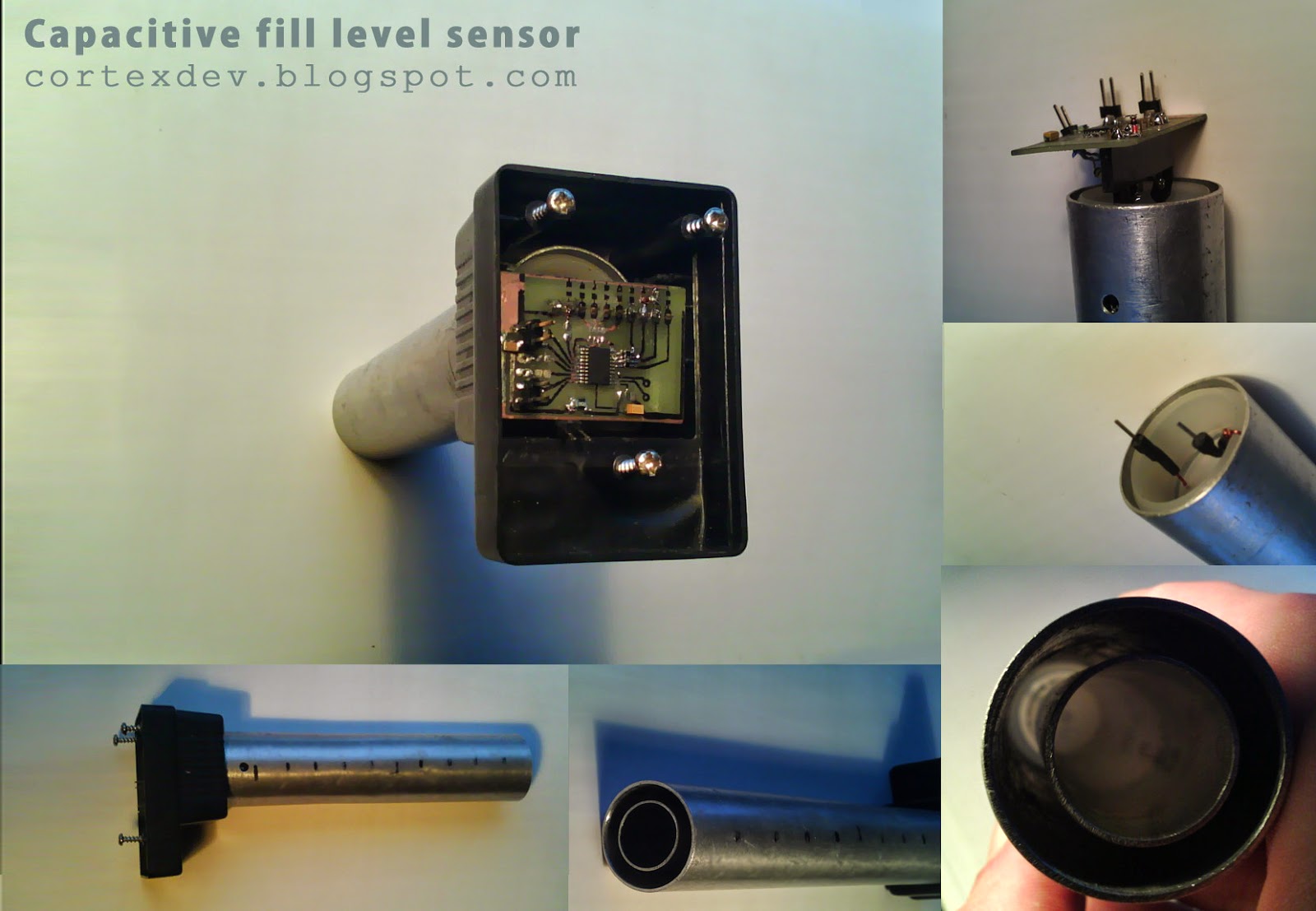
Fill level sensor prototype photos


Capacitive fill level sensor
sensor prototype
Now we can take a closer look at hardware part. It's very simple: two aluminum tubes with plastic spacer on one side. Outer tube grounded, inner wired through spacer by small hole, tight sealed with wire. Spacer must be fully hermetical, especially if  you intends to work with flammable or easy evaporated fluids like gasoline.
Why gasoline? Because it most complicated fluid for capacitive measurements. Gasoline has very low permittivity close to 2 (it means 40 times less than water). Low permittivity leads to low spread of capacitances. It means that filled sensor will have only twice more capacitance than dry one. Literally, we need to measure spread between 20 and 40pF. And sensor copes with it pretty well, shows only 2.5% nonlinearity. It means that kind of sensor can be used for most hard tasks like any types of fuel, refrigerants or even liquid gases.

Thursday, December 11, 2014

Capacitive fluid level sensor

First device in practical examples - sensor for measuring level of a liquid.

Every liquid need to be measured: from liquids in medical life-saving devices and fuel in plane you fly, to refrigerant fluid in industry scaled fridges at food plant and oil in tanks.

Best way to detect  fill level of non-conductive (and conductive also) liquids is using it as dielectric in kind of electrical capacitor, combined of two plates, (in most cases, cylindrical) with gas gap between.

More about: what-is-level-sensor on engineersgarage.com


Effective dielectric constant describes permittivity of liquid
" permittivity relates to a material's ability to transmit (or "permit") an electric field "
Most gases had low dielectric permittivity, instead of liquids, and quantity of liquid in gas gap noticeably rises capacitance. Just measure this, thats all.

Industry very interested in this type of sensors. It not only suitable for liquids itself: this way accurate also on liquid foam, and even in cases were needs to know quantity of liquid in substances (e.g. water in soil).

One or both of plates can be isolated, to avoid resistive loses or to protect plates from chemicals. Or both of them can be leaved non-isolated, if sensor uses in additional resistive measuring. For instance: detecting water in gasoline or salt in water.

Link to some other similar projects :
Capacitive Liquid Level Sensor on mudventions.com
Liquid Level Sensing is Key Technology for Today’s Systems on digikey.com